Flow360 Overview
A brief introduction
What is Flow360?
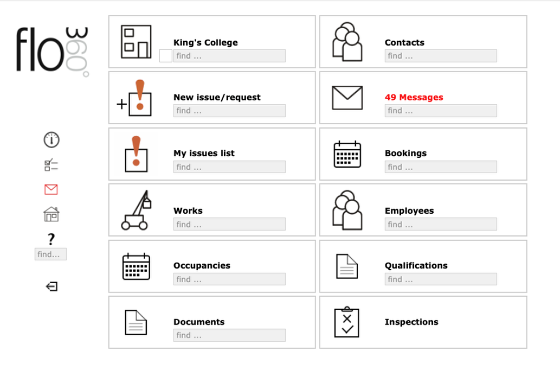
Flow360 is:
Flow360 is one of a new breed of web-based services and collaboration tools. It is designed to make the process of managing and maintaining buildings, sites and their assets as streamlined and transparent as possible. Bringing together all parties involved in these processes, including owners, clients, managers, service providers, surveyors, employees, staff, occupiers and tenants, Flow360 is a fully integrated single solution including...
Assets & Maintenance
Flow360 is a powerful tool for holding and interfacing all key data associated with the fixed assets and moving-stock items you have, their identification and the maintenance requirements relating to them.
Asset recording and documentation handling - A single resource for holding and maintaining all information related to assets, their condition, location and maintenance requirements. Follow intuitive ‘drilling’ routes to access multi-site, single-site or individual room, plant or item records. Linked document storage at each level enables maps, drawings, specifications, manuals, photographs and individual item schematics to be attached.
Planned Maintenance - Create and manage maintenance schedules to assist with budget management, life-cycle planning and resource and work-flow scheduling to ensure that assets continue to perform to their maximum capacity in a cost-effective manner.
Reactive Maintenance - Where unforeseen events do occur, Flow360 can notify relevant stakeholders, identify and communicate with chosen suppliers and monitor and inform on work-in-progress —auditing the repair process from notification through to resolution. The ability to attach documentation to works orders supports Health and Safety compliance and ensures maintenance teams reach sites suitably briefed and equipped to undertake tasks.
Asset Tracking - Flow360 enables individual items to be recorded as assets. These can then be tagged for tracking or recording of maintenance schedules. Flow360 works with partners who specialise in manual, bar-coded and radio-frequency identification tags for asset and equipment management.
Facilities & Helpdesk
Flow360 initiates and audits the actions which are required to get things done within the maintenance process
Help Desk - Provides the initial point of contact for users to raise work requisition orders on-line or via help-desk staff. Flow360 communicates messages to in-house service staff or retained contractors via SMS messaging or any internet enabled device. To speed up the resolution of items raised, Flow360’s Help Desk has access to linked external document storage.
Supplier Relations - Flow360 liaises directly with individual or selected groups of suppliers to facilitate e-tendering, manage price enquiries and issue works orders. Use the integrated National Schedule of Rates for quotation and cost-calculations and shortlist suppliers for works. Flow360 also recognises and supports sub-contract level relationships.
Inspections - Flow360 manages the diary of essential tasks and makes records available to the responsible person anywhere, anytime. In addition, where reactive maintenance works are issued, Flow360 has the ability to identify if routine task requirements could be conducted in parallel, reducing wastage of time and expense per item.
Employees & Training
Flow360 allows you to include your staff and employees. Set up employee contracts, identify internal and external (charge out) costs, maintain time sheets, allocate employees to teams and more.
Flow360 includes flexible staff and employee management allowing you to:
- Allocate staff to resource locations for even faster entry of Helpdesk issues
- Set up employee contracts with salary and on-costs in order to track organisation costs
- Assign employees to teams to allow sharing of responsibility for scheduled tasks
- Maintain time sheets of activity and related costs
Use Flow360 to Manage Training & Qualifications
- Set up employee roles and allocate recommended training and qualifications for each
- Allocate roles to employees and see their training programme automatically populated with the recommended courses
- Manually add existing qualifications complete with awarding body, grades achieved and expiry dates where applicable
- Set alarms for training, qualification, supervision and appraisal dates
- Traffic light warnings provide quick visual check of status of all training and qualifications
- Distribute training materials
- Maintain digital records of certificates and other documentation
Document Management
No more searching for lost documents. Always access the documents you need no matter where in the world you happen to be!
Flow360 allow you to store and link any electronic documents. Attach documents to assets and resources, plant and equipment, scheduled tasks, works orders, Helpdesk issues, employee roles and contracts, training and qualifications - in short any object that exists in Flow360 can have documents linked.
Control Access
You have complete control over who can access your documents. Set the document privacy setting to any of:
- private
- public
- client group
- site group
- services group
... or even specify a distribution list!
Collaboration
Not only can you store and link documents and control who sees them, you can join with others to collaborate on new versions. Set up a collaborators list and any individual on the list can upload new versions!
Full Version Control
Version control ensures that all users of Flow360 will always see the very latest version of any document. If you upload a new version all existing links to the previous version are re-directed at the latest version, thus ensuring the most up to date information is always available.
Carbon & Energy
Flow360 allows you to not only track in real-time the consumption of electricity, gas and water and monitor temperature, but more so delivers comprehensive reporting and trend analysis to inform operational decisions to promote more efficient practices.
A properly serviced asset is not only likely to last longer but is also more energy efficient during its lifetime. Combining information gathered from across the system, Flow360 delivers detailed knowledge of assets and their energy usage against standards to ensure timely servicing and renewal.
Savings of up to 10% on your energy bills can be seen straight away by implementing simple policies and monitoring them using Flow360.